
Boat Oxidation: Why Gel Coat Fades — And When to Detail Before Storage
Quick answer
Boat gel coat oxidizes from UV exposure, salt water, and surface contaminants. Left unaddressed, the chalky gray finish becomes harder to reverse every season — eventually requiring more aggressive compounding that thins the gel coat. The fix is multi-stage oxidation removal followed by a UV-protective sealant, ideally done twice a year: once before launch in spring, and once before storage in fall. The fall service is the one most owners skip and the one that prevents the worst long-term damage.
By Al Alvarez
Owner & master detailer · 6+ years on Long Island
Every boat on Long Island has the same enemy: the same sun and salt water that make boating great here are also actively breaking down the gel coat every day the boat is in the water or sitting outside uncovered. Most owners notice when it’s too late — when the hull’s gone visibly gray and the wax isn’t beading anymore.
This post is about the chemistry behind gel coat oxidation, what oxidation removal actually does, and when to schedule it relative to the boating season — particularly the fall service most owners skip.
What gel coat oxidation actually is
A new boat hull has a glossy, color-saturated gel coat — a thin layer of polyester resin pigmented to whatever color the manufacturer specified. Gel coat is harder than automotive clear coat but more porous, and unlike clear coat it doesn’t have a UV-protective base coat underneath. The pigment is in the gel coat itself.
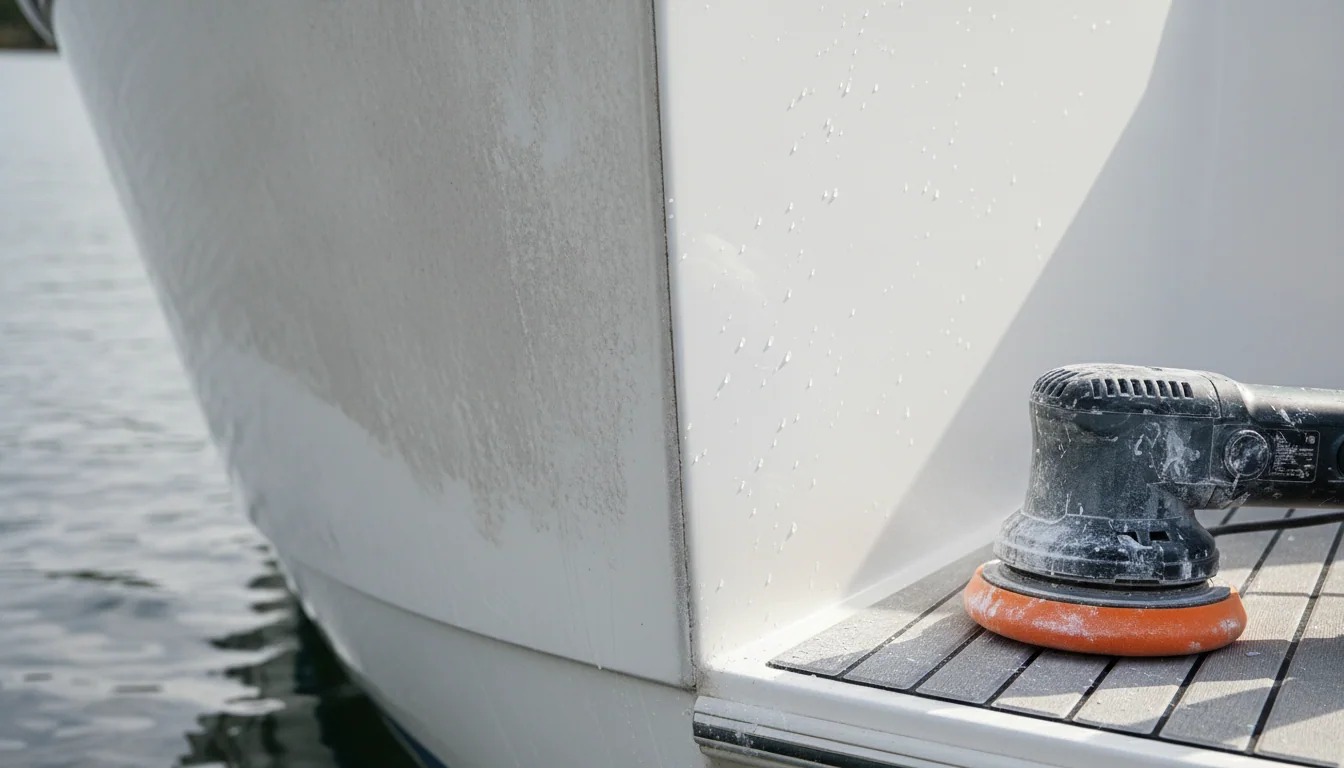
UV light breaks down the resin at a molecular level. As the resin degrades, the surface becomes microscopically rough — light scatters instead of reflecting, and the color reads as washed-out and chalky. Salt water and airborne contaminants embed in those microscopic pores, accelerating the breakdown.
Three to five years of consistent UV exposure without protection takes a hull from glossy to chalky. Five to ten years takes it from chalky to deeply oxidized — the color goes flat, sometimes turning yellow or pink depending on the original pigment.
The good news: oxidation is a surface effect, not structural damage. The pigment under the chalk is still intact. Compounding removes the degraded outer layer and exposes fresh, glossy gel coat underneath.
What “oxidation removal” actually does
A proper oxidation removal is multi-stage:
- Wash. Marine-safe shampoo strips loose dirt, algae, mineral deposits, and bird droppings. Pressure is kept low — no power washing on oxidized gel coat, which can drive water into the porous surface and cause more issues.
- Decontamination. Iron and mineral deposits embedded in the gel coat get pulled out chemically before any compounding starts. Skipping this step grinds those contaminants into the surface during compounding.
- Compound. A rotary or dual-action polisher with an oxidation-removal compound levels the chalky surface. The compound abrasive is matched to the severity — finishing compound for light oxidation, medium-cut for moderate chalk, heavy cut only on severely neglected hulls.
- Polish. A finishing polish removes the haze and micro-scratches left by the compound, bringing back the deep gloss.
- Seal. An SiO₂-based marine sealant bonds to the freshly polished surface and provides UV protection through the season.
The compound and polish steps are where the actual oxidation goes away. Done right, this is a one-time fix per season — the gloss holds until next year if the sealant stays intact.
The fall service is the one that matters most
Most boat owners book a detail in the spring before launch. That makes sense — boat looks good for the season, water beads off, salt rinses off easily, mid-season touch-ups stay easy.
What gets skipped: the fall service, before winter storage.
This is the one we recommend most strongly, and it’s the one that prevents the worst gel coat damage long-term. Here’s why:
- Salt is corrosive over time. A boat put away in October with last summer’s salt still on the hull spends six months with that salt slowly etching the gel coat.
- Contaminants embed during storage. Anything sitting on the hull when storage starts — bird droppings, fish blood, tree sap, atmospheric pollutants — has six months to set in.
- A sealed hull weathers storage better. Whether shrink-wrapped or stored uncovered, a freshly sealed hull comes through the off-season far cleaner than a dirty one.
- Spring service gets faster and cheaper. A properly fall-detailed boat needs a light wash and re-seal in spring, not a full oxidation removal. The cumulative cost over the boat’s life is lower.
The pattern that works:
- Fall (October-November): Full oxidation removal if needed, decontamination, polish, seal. Boat goes into storage clean.
- Spring (April-May): Wash, light polish if necessary, re-seal. Boat goes back in the water glossy.
- Mid-season (optional, July): Touch-up wash and re-seal for high-use boats or boats that took a beating from a storm.
That’s three services for boats stored outside or in the water. Two if stored indoors.
When to know you need it
Signs the boat is overdue for oxidation removal:
- Color looks washed out compared to similar boats in better condition.
- Hull feels rough when you run a clean cloth across it after washing. A well-maintained gel coat feels smooth — like glass. Oxidized gel coat feels like fine sandpaper.
- Water doesn’t bead off cleanly after a rinse. If water sheets and leaves spots, the sealant has worn through and the gel coat is unprotected.
- Visible chalk transfers to a clean cloth when you wipe the hull down. That chalky residue is degraded resin coming off.
Any of those signs means oxidation removal is the next service. Waiting a year doesn’t save money — it makes the eventual fix more aggressive and shortens the gel coat’s effective life.
Booking before storage
The fall window is short and books fast. Most marinas in the area pull boats between mid-October and Thanksgiving, which means oxidation removal needs to happen before haul-out — ideally in the two weeks before the boat leaves the water.
Request a quote — tell us the boat’s length, where it’s stored, and roughly when it’s coming out of the water. We’ll book a slot before haul-out, deliver the oxidation removal and seal, and your boat goes into storage protected for the off-season.
For the full overview of what’s included in boat service, see the Boat Detailing service page.
Related reading
- Why Salt Air Destroys Car Paint on the East End (And How to Fix It) — same chemistry on a different surface, and useful background for boat owners with cars parked near the coast.
- Auto Detailing Checklist Before Summer — the seasonal-prep mindset applied to vehicles.