
Restoring a Faded Backyard Water Slide: What It Actually Takes
Quick answer
Backyard water slides fade because the fiberglass and gel coat oxidize under UV exposure and pool chemicals — the bright original color goes chalky and gray within 3-5 seasons. Restoration is a multi-stage process: deep wash, oxidation removal with progressively finer compounds, machine polish to bring back the original gloss, and a UV-protective sealant to slow the next round of fading. Done right, a faded slide returns to roughly 80-95% of its factory color. Pricing is custom — based on slide size, condition, and access. Annual re-sealing extends the result for 2-4 years before another full restoration is needed.
By Al Alvarez
Owner & master detailer · 6+ years on Long Island
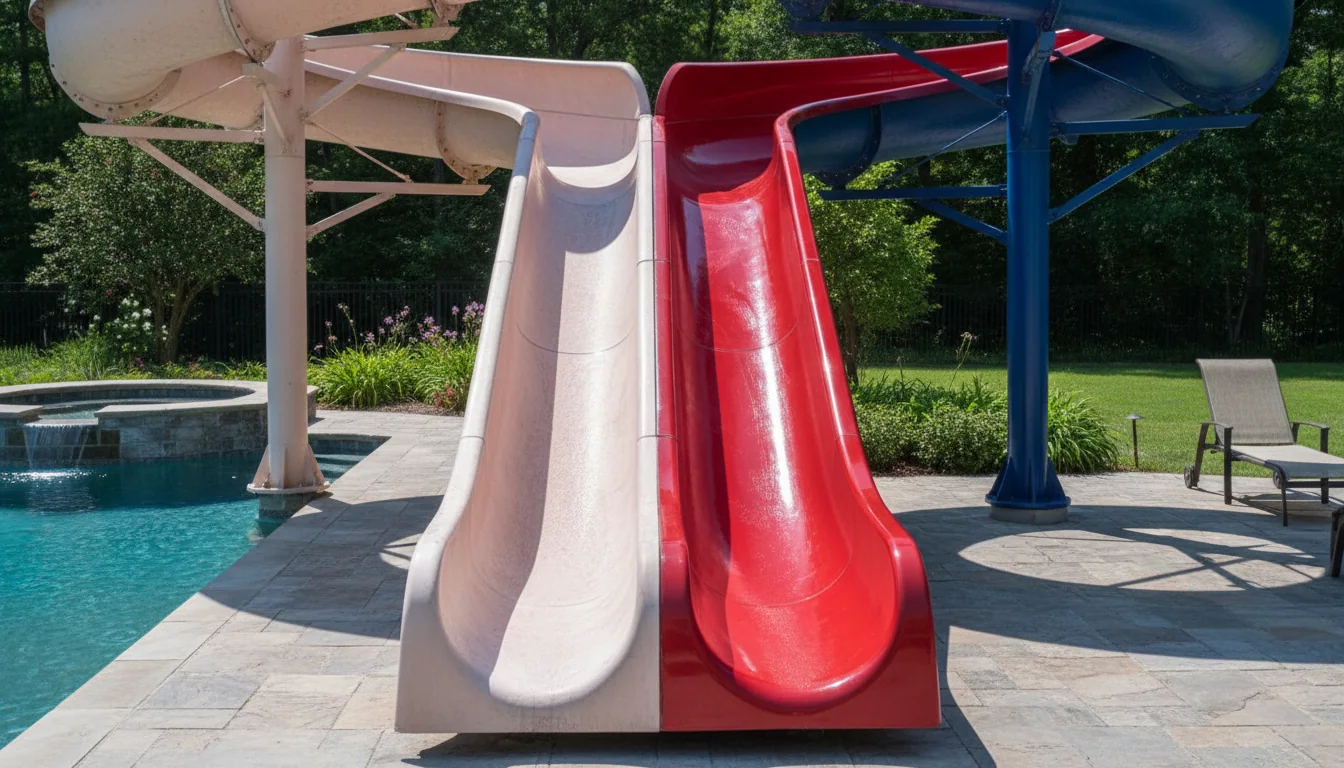
A backyard water slide on Long Island has maybe a five-year window before it looks visibly tired. Three of those years it looks great. The next two it starts to chalk, the bright original red or blue going pale and gray, and by year five it’s flat, rough to the touch, and starting to drag on the way down.
This is the same chemistry that fades boat hulls and faded RV exteriors — gel coat over fiberglass — but slides take a more aggressive beating. UV is harsh enough on its own; UV plus pool chemicals (chlorine, salt-cell residue, algaecides) plus the constant micro-abrasion from bathing suits accelerates everything.
The good news: oxidation is a surface problem, and surface problems are fixable. This post is about what restoring a faded slide actually involves, when to call it, and what to expect.
What’s actually happening to the slide
Fiberglass slides are built like boat hulls: a fiberglass mat layered with resin, then sprayed with a gel coat that contains the pigment. The gel coat is the “color layer” — it’s not paint sitting on top of fiberglass; it’s a thin layer of pigmented resin that’s part of the structure.
When that gel coat is new, it’s glossy, the color is saturated, and the surface is smooth. UV exposure breaks down the resin from the top down. The first signs are subtle:
- Year 1-2: Surface looks fine. Color still vivid.
- Year 3: A faint chalkiness shows up in direct light, especially on horizontal surfaces. The color reads slightly muted.
- Year 4-5: Chalk is obvious. Color has gone flat and pale. Surface feels rougher.
- Year 6+: Heavy chalking, color barely recognizable, surface feels almost like fine sandpaper. The slide is functionally slower than it used to be.
By year five, owners typically notice. The slide isn’t broken — it still works — but it looks tired, the kids comment, and the original bright color is gone.
What restoration actually does
Restoration isn’t paint and it isn’t a chemical recolor. It’s a physical process that removes the degraded outer layer of gel coat and exposes fresh, saturated gel coat underneath. Done in stages:
- Deep wash. Non-abrasive cleaners strip surface grime, algae, mineral deposits, and chalked oxidation. We avoid pressure washing on oxidized gel coat — it can drive water into the porous degraded surface.
- Decontamination. Mineral deposits and embedded contaminants get pulled out chemically before any compounding starts. Skipping this step grinds those contaminants into the surface during the next phase.
- Multi-stage oxidation removal. A variable-speed rotary or dual-action polisher works through compounds from heavy-cut to medium-cut to finishing-grade. Each pass levels a thin layer of the degraded gel coat. The pigment underneath gets brighter with every pass.
- Machine polish. A finishing polish removes the haze left by the compounds, bringing back the deep gloss the slide had when it was new.
- UV sealant. An acrylic or SiO₂-based sealant bonds to the freshly polished surface and adds a UV-resistant top layer. This is what determines how long the result lasts.
For a typical backyard residential slide in moderate condition, this is a one-day job. Heavier oxidation or larger commercial slides take longer.
What it looks like after
Realistic expectations:
- Color is back, not new. Original-factory color comes back roughly 80-95% on a slide that’s been faded for 3-5 years. A slide that’s been chalked for a decade may come back closer to 70-80% — most of the pigment is still recoverable, but the gel coat has thinned enough that some color saturation is permanently lost.
- Surface is smoother than new on touch. The compound and polish leave the surface very smooth — actually slipperier than it was at year 3 of normal wear. We can spec the sealant for slip behavior depending on the use case.
- Gloss is back. The matte chalky surface returns to a noticeable gloss. Photographs look dramatically different — most owners take “before” photos that turn into great social proof.
When to schedule
Best time of year on Long Island: late April through May, as pools are opening. That’s the window most owners notice the fade because the slide is back in use and the contrast with the surrounding fresh pool is obvious. Booking in early April locks in a slot before the early-summer rush.
Fall service (September-October) is also good — the slide goes into winter sealed against UV and weather, which protects what’s there even when it’s not in use.
A common pattern that works: full restoration every 3-4 years, with a UV re-seal every year in between. Annual re-sealing is cheap compared to a full restoration and extends the time before the next big service.
When restoration isn’t the right call
A few situations where restoration isn’t enough:
- Cracks or exposed fiberglass weave. Those need fiberglass repair first, then restoration. We don’t do fiberglass repair — that’s a structural specialist’s work. Once repaired, the slide is a normal restoration candidate.
- Structural damage at joints or supports. Same answer — repair first.
- Inflatable slides. Different surface entirely. This service is for fiberglass / gel coat slides only.
- Pool surfaces themselves. Pool plaster and tile aren’t gel coat. Pool resurfacing is a different trade.
If you’re unsure, send a photo and we’ll tell you straight whether restoration is the right move or if there’s structural work to handle first.
Booking the service
Request a quote — send a photo of the slide, the overall length, and a note on roughly how rough the surface feels. We’ll send a quote the same day, schedule the service, and arrive with everything needed to complete it in a day for most backyard slides.
For the full overview of what’s included, see the Water Slide Restoration service page.
Related reading
- Boat Oxidation: Why Gel Coat Fades — And When to Detail Before Storage — same chemistry on a different surface.
- Why Salt Air Destroys Car Paint on the East End (And How to Fix It) — the UV side of the same problem on a third surface.